
EDITH: Inst. 13
a little culture


58 Rue de Varenne was undergoing renovations, so she took rooms at the Ritz. Walter loved the Ritz. Edith loved service.
Walter wrote from Cairo: he could see Ethan Frome trudging through the snow. He’d been reading her drafts in between his work and social schedule. If he realized that Edith was Ethan, he did not seem to know that he was not Mattie, and she did not enlighten him. His behavior aboard the ship had indicated that he rather fancied Edith on a sled going swiftly downhill. If he was too skittish to leap on behind her, she knew someone stealthier – if only she could get a response from Morton!
Here I am again, in a very nice apartment up in the sky, overlooking the whole of Paris, & consequently very cool; & here I am likely to stay for some time, she wrote to John Hugh Smith. I don’t think Teddy will need to keep his boots in the library, but the absence of such picturesque touches will be atoned for by the vulgar convenience of his being able to leave his room without going through the drawing room . . . How I wish you were here to prowl for furniture with me! It’s just the season for bargains1.
Her husband was in Pau, where golf had been invented. He might not make it to Paris, but if he did, the layout of the suite would prevent his interference, boots or otherwise, in her rooms.
I enjoy Paris more & more, Edith wrote to Sally Norton, as I get hold of more agreeable & interesting people -- & the climate seems just what I need. No throats, no hoarseness, no asthma – because there is no dust, & no change of temperature of 40 degrees in a night –
And there is the intolerable pressure! Henry wrote to Howard of the infinite Howardisms: her bed is so made and such a great big uncompromising four-poster!
Howard wrote to Edith: Fly your flight, live your romance, drain the cup of pleasure to the dregs!
Where was this cup? She suspected that Fullerton could sense that their mutual friends had found out about their affair; she felt as if he were holding back to torture her, to prove that the affair was a figment of her imagination.
A month after Edith’s arrival at the Ritz, he wrote. She read the letter in alternating bouts of relief and rage, then hid it in the lap desk standing by her bedside, the same lap desk she used to write every morning. After several sleepless nights, she wrote a response:
I don’t know what you want, or what I am! You write to me like a lover, you treat me like a casual acquaintance! Which are you – what am I?
She had learned a little of Fullerton’s history, of his men and his women. An English lord with a penchant for sculpture. Had Lord Ronald Glower grown tired of learning the form of Fullerton – or had he not had his hands on him often enough? Perhaps that was why there was no sculpture called ‘Mortie’ – or whatever Glower had called him. ‘Billy,’ she imagined the lord calling the journalist, laughing to think how incensed Fullerton would have been by the nickname.
No serious writer could be called Billy, he would rage. And what was another William, after the bard? William Morton Fullerton had set his sights so high he could never even begin to fulfill the promise of his own talent; he hardly tried. Fullerton never finished anything that didn’t result in his own pleasure, let alone a work of literature.
Next on the list came the Ranee of Sarawak, Lady Margaret Brooke. Henry had admitted his role in introducing Fullerton, fresh from Harvard, to the formidable woman. He’d meant to impress the younger man with his connections, not lose to the old gal – a phrase Henry had attempted to modify mid-speech. His speech was now at a pace with his mastication and Edith caught it in full. She could hear the turn of his tongue trying to keep up with his mind. He did not mean to reveal that he had chased Edith’s lover, any more than he meant to imply that Fullerton liked ‘old’ women. Edith was nowhere near the Ranee’s sixty years, but she did feel Henry’s implication: here was a man with specific, peculiar tastes.
Specific, certainly; peculiar, possibly; but above all, delicious. She wanted Fullerton to run away with her. Anywhere. But he was rarely to be found in his own apartment. He had, apparently, been out of doors: in response to her last letter, he’d sent her a sprig of witch hazel. An irritating and intoxicating non-answer to her question!
If only he’d known me when I was YOUNG, Henry couldn’t help gasping as she shared her worries over tea at the Ritz, but this was one wish Edith did not share. She had not been prepared, as a youth, for anything other than statues and corsages; her husband had been cold as the former and as conventional as the latter, and Walter had done her a great service in helping her unlearn Teddy’s poor treatment. But Walter was more tutor than scholar, and a cautious one at that. Fullerton’s sprig of witch hazel was a joke at the paroxysm she’d enjoyed beneath a tree in the woods in Lenox. Had she been under those boughs with anything less than her forty-five years, she’d have died of shame, not pleasure.
What was it she had thought when she was young? That others actually noticed anything at all about her? That anyone could guess the cause of a blush flashing across her face? Only her mother had attributed crimes to Edith, each and every accusation sketched out of Lucretia’s own experience, delivered onto the daughter she had borne as a consequence. It had not been fun being young and full of shame – particularly shame she hadn’t done anything to earn.
But no fun was to be had in the present, either: that was what a scan of the Parisian scene said to the pragmatist in Edith’s head, who scolded her heart. The Comtesse de Fitz-James had not blinked at Edith’s hungry surveillance of the crowd in her drawing room. She knew the man Edith was looking for, and instead handed Edith his newspaper.
He’s written a new column this week. Tell me, my dear, is it any good?
The Comtesse had often asked Edith the same question about books they’d both already read, but Edith suspected Rosa wasn’t asking about the column. She glanced at the column, then looked up at the calm Comtesse.
It’s not art, is it? Edith asked, for once uncertain what to say to her friend but confident, at least, in their shared sense of aesthetics.
A form of it, perhaps. Seeing the exasperation in Edith’s expression, the Comtesse relaxed.
Longer lasting than a conversation, she said. But not as dear as a letter.
Letters!
Quite expensive, you know, when the writer is dead, the Comtesse continued. I heard from an agent of mine – confidentially – that our mutual friend was trying to sell a letter Oscar Wilde once sent him, asking for a loan after, you know, his imprisonment.
The Comtesse paused to sip her champagne contemplatively.
He’s tried to sell an old letter of Wilde’s? Edith’s mind was flipping in synchronicity with her stomach. Tell me the good poet got what he requested!
Has our friend ever given anyone what they requested? sighed the Comtesse.
Fullerton’s pecuniary flaws were well-known to Edith; they were well-known to everyone. He could be generous in a physical sense, but that was where his generosity ended. The man was forever borrowing money. Henry had helped her settle a sum of Fullerton’s, more to save his own sense of honor than out of necessity. Edith could better afford her lover’s mistakes than Henry could afford his own housekeeper. She was well aware that Fullerton was being extorted by his landlady – who was technically his common-law wife, but for the actual wife he’d wed for one year, who’d left him (so he claimed) to continue her career as an opera singer.
As if these complications were but a passing distraction, Morton was also struggling to extricate himself from an impulsive engagement to his adopted sister, a cousin his parents had taken in after her father disappeared and her mother died. (He must be telling the truth! huffed Henry at her mention of the sister-cousin. He is not kind. Not kind.)
Edith had been irritated by Fullerton’s confession of a brief entanglement with a mid-Westerner named Blanche who called herself a novelist, but otherwise she did not care what the man did with English lord-sculptors, with Ranees, with landladies, with opera singers, or with his incestuously close relations. In fact, she was curious to find out what he did. What exactly. She often asked him What did you...?
But he always interrupted her question with gestures of his own, very persuasive gestures. In direct contradiction to appearances – his intense, attentive appearance – he was not a good listener, Morton Fullerton; one had to be firm; one had to repeat oneself; one had to get one’s letters back before he tried to sell them to pay off his landlady. Edith wanted the letters she had written to William Morton Fullerton, and she immediately wrote to say so.
The letters were not as forthcoming as the man, who came to tea with Henry in Edith’s rooms and confessed that he was overwhelmed by the sister-cousin-fiancée situation. Edith had mentioned the sister-cousin to Henry but omitted news of the engagement.
How...? Henry paused long enough that both Fullerton and Edith knew no other word would follow. Edith took a slow sip of tea and settled comfortably into her seat. She wanted to hear how Morton would answer Henry’s question.
She was very – so very – enraptured . . . Fullerton had fumbled, lost in a memory Edith could not help herself from imagining as being situated in a forest, much like the one in which he had ruined her dress and decimated some witch hazel. The man had grown up in New England, after all.
Bring her to Paris, she ordered calmly, more to snap him out of the reverie than out of any particular desire to share a city with the sister-cousin, this child who (Fullerton had confided) was teaching The House of Mirth to debutantes at Bryn Mawr.
Bring her, Edith said.
***
She sat in a restaurant waiting for Fullerton to arrive with his guest. She wasn’t afraid of a little provincial called ‘Kittie’.
And when the brown bonnet bobbed into the fashionable tea rooms at the Ritz, Edith all but choked in sympathy: the poor child had read too much Louisa May Alcott. Kittie clearly thought she was come to save her cousin’s (brother’s?) soul with her simplicity. Fashion from the prior century was one of her weapons.
Wrong tree! Edith wanted to hiss at this kitten. Go back to your students; save yourself some trouble.
But trouble Miss Katharine would have. She had mistaken it for sin, and sin she must confront like a good housekeeper staring down a dust bunny. Kittie had not understood that dust is the element of which Man is made. Nor did she grasp that doors were an invention of society, one which simply did not apply to Fullerton: wherever he went, doors opened as if they had never been closed, as if they had been designed simply to frame his physique! He was as natural in a boudoir as in a salon, as himself in a library as in a city crowd, as adept on a chaise longue as against a tree –
Mrs. Wharton I must request an interview with you, said a stupidly young voice.
My dear we’re having one presently, are we not?
Excuse me, please, I’ve prepared a list of questions which would aid me in my research for my lectures. I do hope you’ll expound upon the morality and motivations behind your great themes.
This Kittie had masterminded a scheme to eliminate Edith through sheer boredom and presumed vanity: expound upon the morality and motivations of her writing?! So her books were organized on moral principles, were they? For the benefit of the Christian public, no doubt.
Edith began to see a way in which this child’s impulses might be redirected away from Fullerton. Edith had been having trouble redirecting her own, but Kittie’s were so very visible. She wondered, for instance, what Fullerton had convinced young Kittie to do under the auspices of reforming his soul. Perhaps the convincing had come from the girl herself, this one with her list of questions. Her research!
An Alcott heroine came to mind, the “Old-fashioned Girl” who left the country to live in the city with rich relations. The girl fell in love with her cousin Tom, a boy she wanted only to reform – and did so, tearfully, in a closet beneath the stairs, after which they were quickly married. The purportedly chaste closet interlude might have fooled its own writer. Alcott had likely never been kissed by a human person, let alone in a closet; it had certainly fooled dear young Kittie, who would have surrendered all her humble earthliness in the name of her lord, no doubt, in a closet beneath the stairs or on a table at a restaurant, such was her – what had Fullerton called it? - her rapture.
But Kittie did not fool Edith, no, not when ‘Tom’ was pacing nervously, no doubt thinking of all the things he could do and had done to Kittie in the most inconvenient of spaces and the greatest variety of places. He was an artist, our ‘Tom’ – she’d grant Kittie that.
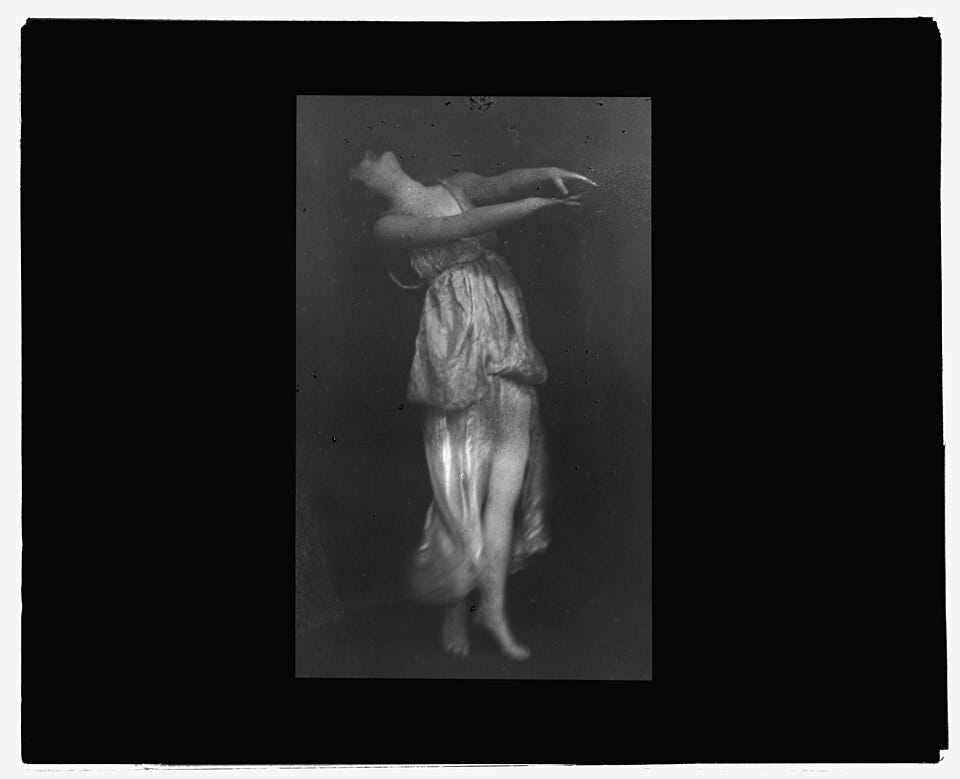
The brown bonnet had been removed and an earnest face was imploring Mrs. Wharton to share her views – even if critical – of the state of American literature. Edith resolved to say as little as possible until she could take this child to see Isadora Duncan. She wanted to see that open, plain, Puritanical face react to the naked legs of the dancer. Let that speak for her views on the morality of art!
***
Morton escorted Edith and Kittie into the amphitheater with such propriety that Edith wondered whether some might mistake them for a family. Certainly Fullerton and his sister-cousin had some facial features in common; not the jaw-line, but something in the brow – yes, there was a resemblance!
Edith did not look like anyone’s mother, she was sure of that, but the girl was twenty years her junior; it was possible. But they were not likely to be taken for family, given the fourth wheel of Carl Snyder, a friend Morton had dug up at the last minute. The four of them had piled into She, White struggling furiously not to raise his eyebrows while Edith allowed herself to be seated next to the brown bonnet. Four passengers had never burst out of the vehicle as quickly as when She pulled up to the venue.
The outdoor theater had been designed in Greek Revival style, and the dancer took full advantage of her stage. Isadora Duncan looked as if a statue of a Greek goddess had come to life. Lines of pleated Fortuny silk spilled over every curve. Kittie’s eyes grew wide at the sight, though she seemed not to notice the bonnet-less heads of her peers all about her. Morton pretended to read the program and Carl Snyder, seated on the other side of his friend, looked as if he were on a lark.
The San Franciscan dancer first lifted a leg, naked of stocking or slipper.
Kittie gasped. Visibly shaken but resolved to take in a little culture, Kittie did not make a sound for the rest of the performance. At its conclusion, she seemed moved, which did not surprise Edith. Had the child ever seen a woman do something other than sit or stand? This was what should have been the young woman’s world, one in which a dancer might enact all the agonies of the ancients with the aesthetics of modern art.
Edith wished someone had shown her such a world at Kittie’s age. The early entrapment of her marriage, those years in Newport in the old cottage on her mother’s property, gave her a sort of empathy towards this girl. Newport was not Bryn Mawr, but the parallels were clear enough.
And what did dear Morton need, more than reform? He needed to pursue his gift for literature, and for that, Morton needed culture. Kittie’s mind seemed to absorb these facts as plain brown bread sops up gravy. A little champagne didn’t hurt her comprehension, either.
I hadn’t talked with her an hour before it seemed to me the inevitable solution, or outcome, Edith later told her lover. He had escorted Kittie back to her hotel after the performance and returned to Edith the same evening, relieved that his would-be bride had gratefully accepted his suggestion that they delay their nuptials.
But the solution might not have come so easily. After a series of standing ovations, as the small party exited their row, Carl waited in the aisle to take Edith’s arm. He slipped a note into her hand, having found it earlier in the car. A quick glance revealed her own handwriting; Fullerton had dropped it.
And if Kittie – not Carl – had picked it up?
She’d have seen that Edith could plot more than novels.
The Letters of Edith Wharton, ed. by R.W.B. Lewis and Nancy Lewis
I marvel over and over how tough Edith was. Or seemed to be. Fullerton's behavior is the kind that could compromise a woman's immune system, let alone her peace of mind. Do you think having all that money helped toughen her?